
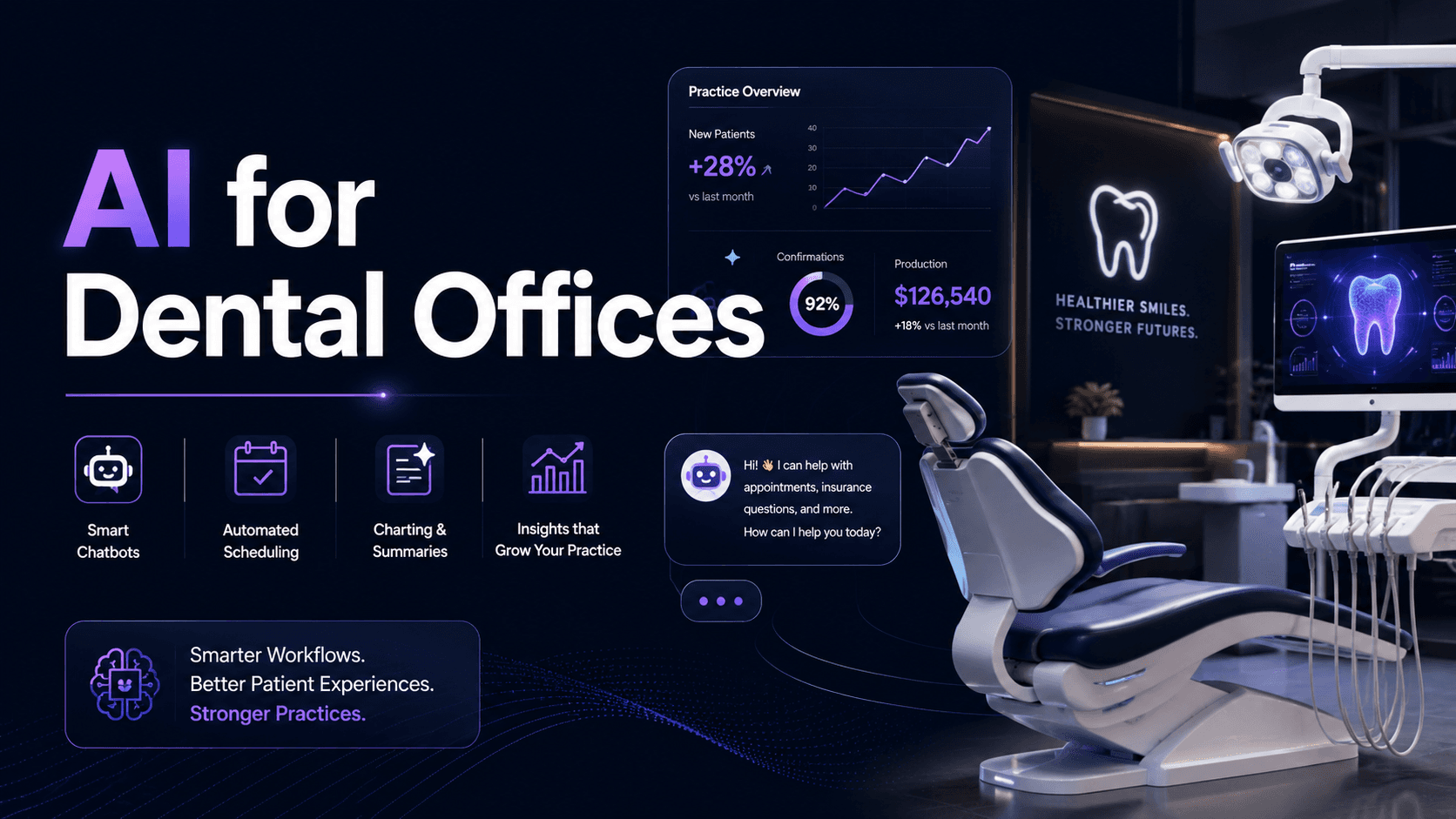
AI for dental offices refers to software tools that automate patient communication, scheduling, follow-up, and marketing tasks that would otherwise require staff time or go undone entirely. These tools are not experimental. Thousands of dental practices across North America are using them right now to reduce no-shows, respond to leads faster, and keep their appointment books full with less manual effort.
This article covers what AI actually does inside a dental practice, which tasks it handles well, and where it genuinely moves the needle for growth.
What Can AI Actually Do in a Dental Office?
AI in dentistry is not one product. It is a category of tools that each solve a specific problem. The most impactful applications fall into five areas.
Automated patient communication. AI-powered messaging tools send appointment reminders, recall notices, and follow-up messages automatically. They respond to patient texts and form submissions in seconds, even outside office hours. Most patients who do not get a fast response will simply call the next practice on the list.
Intelligent scheduling. Some AI systems analyze your schedule in real time, identify gaps, and send targeted outreach to patients who are overdue for care. This fills calendar holes without your front desk making manual calls.
Review generation. AI tools send review requests automatically after appointments. Consistent, high-volume reviews strengthen your Google Business Profile ranking in ways that sporadic, staff-driven requests cannot match.
Lead response and chatbots. Website chatbots answer common questions, pre-qualify patients, and capture contact information around the clock. According to research from Harvard Business Review, responding to a lead within five minutes makes you nearly 100 times more likely to convert them than waiting 30 minutes or longer.
Marketing personalization. AI tools segment your patient list by last visit date, treatment history, or insurance type and send targeted messages that match what each patient actually needs. This replaces generic blast emails with communication that feels relevant and timely.
Where AI Makes the Biggest Difference
Not every AI application delivers equal value. Here is where most dental offices see the clearest return.
Area | What AI Automates | Why It Matters |
|---|---|---|
Appointment reminders | Text and email sequences | Reduces no-shows consistently |
After-hours lead response | Instant chat and text replies | Captures patients before they call elsewhere |
Recall campaigns | Automated outreach to overdue patients | Fills schedule gaps without staff calls |
Review requests | Post-visit follow-up messages | Builds Google ranking and patient trust |
New patient onboarding | Forms, confirmations, intake steps | Reduces front desk friction |
The common thread is speed and consistency. AI does not forget. It does not have a bad day. It executes the same follow-up process every single time, which is something even the best-run front desks struggle to guarantee.
What AI Cannot Replace
AI handles communication and automation well. It does not replace clinical judgment, and it does not replace the human relationships that keep patients loyal to your practice over the long term.
The right way to think about it: AI takes the repetitive, time-sensitive tasks that currently fall through the cracks and handles them reliably. That frees your team to focus on in-office patient experience and case acceptance, where human connection actually matters.
"The practices that see the biggest gains from AI are the ones that use it to handle the routine so their team can focus on the relationship. It is not about replacing people. It is about not dropping the ball on the steps that happen between appointments."
How AI Fits Into a Patient Acquisition System
AI is most valuable when it connects to a broader marketing and operations system. A practice running paid ads or investing in local SEO but lacking automated follow-up is leaking new patients at every step.