
Most dental practices don't have a patient problem. They have a production gap.
The revenue opportunity is already in your building. It's sitting in incomplete treatment plans, patients who fell out of recall, services your existing patients don't know you offer, and cases that were declined but never followed up. Before you spend more on ads or chase new patient numbers, it's worth understanding how much production you're already leaving behind.
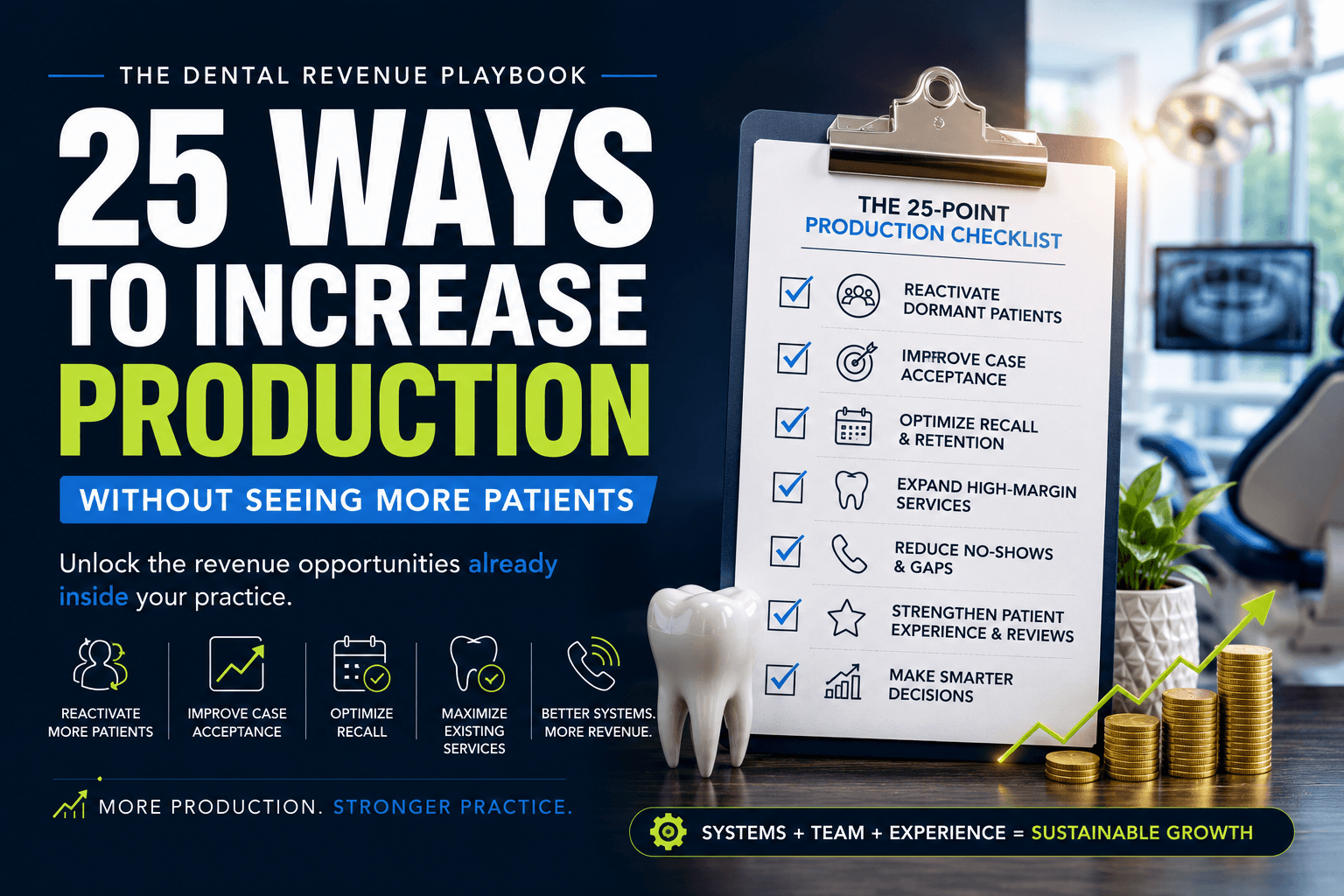
This playbook covers 25 specific strategies to grow production without adding a single new patient to your schedule.
According to the Canadian Dental Association, a significant portion of Canadians delay or skip recommended dental treatment due to cost concerns or perceived (lack of) urgency, which means the treatment need is real inside your existing base. The gap is usually in how that need gets surfaced and followed up.
Why Your Existing Patients Are Your Biggest Growth Lever
The average established practice retains most of its patient base but captures only a fraction of the available treatment per patient. Patients miss hygiene appointments, decline work they can't visualize, and simply don't know about the cosmetic or restorative options you offer.
In our experience working with Canadian dental practices, the two areas that consistently hold the most recoverable production are recall and case acceptance. Fix those two before anything else.
"The practices that grow consistently aren't always the ones with the most new patients. They're the ones that have built reliable systems around the patients they already have."
Reactivation and Recall Optimization
1. Build a reactivation system for dormant patients. Any patient you haven't seen in 18 months is a reactivation opportunity. A short sequence of text, email, and phone outreach can bring a meaningful portion back without any ad spend.
2. Automate recall reminders before patients fall out of the cycle. Send reminders at 4 months, 5 months, and 5.5 months. Don't wait until they're already late. Getting ahead of the gap keeps more patients in rotation.
3. Track your reappointment rate. Make hygiene reappointment rate one of your top five KPIs. Aim for at least 90% of hygiene patients leaving with their next appointment booked before they walk out the door.
Treatment Acceptance
4. Present full treatment plans, not just the urgent item. Patients who only hear about their most pressing need never get the chance to say yes to everything else. Present the complete picture with clear context and options.
5. Use intraoral cameras at every appointment. When a patient can see a cracked cusp or failing margin on a screen, case acceptance improves significantly. Research published in the Journal of the American Dental Association has linked visual patient education tools to measurable gains in same-day treatment acceptance. This is one of the highest-return investments in your clinical toolkit.
6. Review how financing is presented, not whether it's offered.
7. Follow up on declined treatment within 30 days. Most practices don't have a structured process for this. A brief, non-pushy check-in by phone or text recaptures a meaningful percentage of cases that patients said no to in the chair.
8. Train your team on fee presentation. How fees are presented affects whether patients move forward. Front desk and clinical staff who present clearly and confidently, without apologizing for costs, see better results.
Service Mix Expansion
9. Promote teeth whitening as a standalone service. It's high-margin, low-overhead, and most patients assume their general dentist doesn't focus on cosmetics. A small shift in how you communicate this service changes that assumption.
10. Identify high-margin services your practice isn't consistently discussing. Examples:
Clear aligners
Whitening
Night guards
Botox (where applicable)
Sleep appliances
Implants
11. Introduce sleep appliance services. Snoring and mild-to-moderate obstructive sleep apnea affect a large portion of Canadian adults. Mandibular advancement devices are billable under many provincial fee guides and are often overlooked by general practices.
12. Proactively offer implant consultations to existing denture and partial patients. These patients are already in your practice. Many are candidates for implant-supported solutions and don't know it's an option with you.
13. Keep periodontal therapy in-house. Scaling and root planing with a maintenance protocol adds recurring revenue. Many practices refer out perio cases that could be treated by the hygiene team.
Hygiene Productivity
14. Add adjunctive hygiene services. Adult fluoride, sealants, gingival irrigation, and caries risk assessments are all billable under most Canadian provincial fee guides. They add value to the appointment and support preventive care.
15. Book the right amount of time per patient. Protect production time by matching appointment length to patient complexity.