

Most dental practice owners know they need to have some kind of marketing plan for their clinic. The harder question is how much to actually spend, and whether their budget is working.
There is no single correct number. But there are well-established benchmarks, clear factors that shift the range up or down, and a smarter way to evaluate whether your spend is justified. This guide walks through all three.
What Is a Reasonable Dental Marketing Budget in Canada?
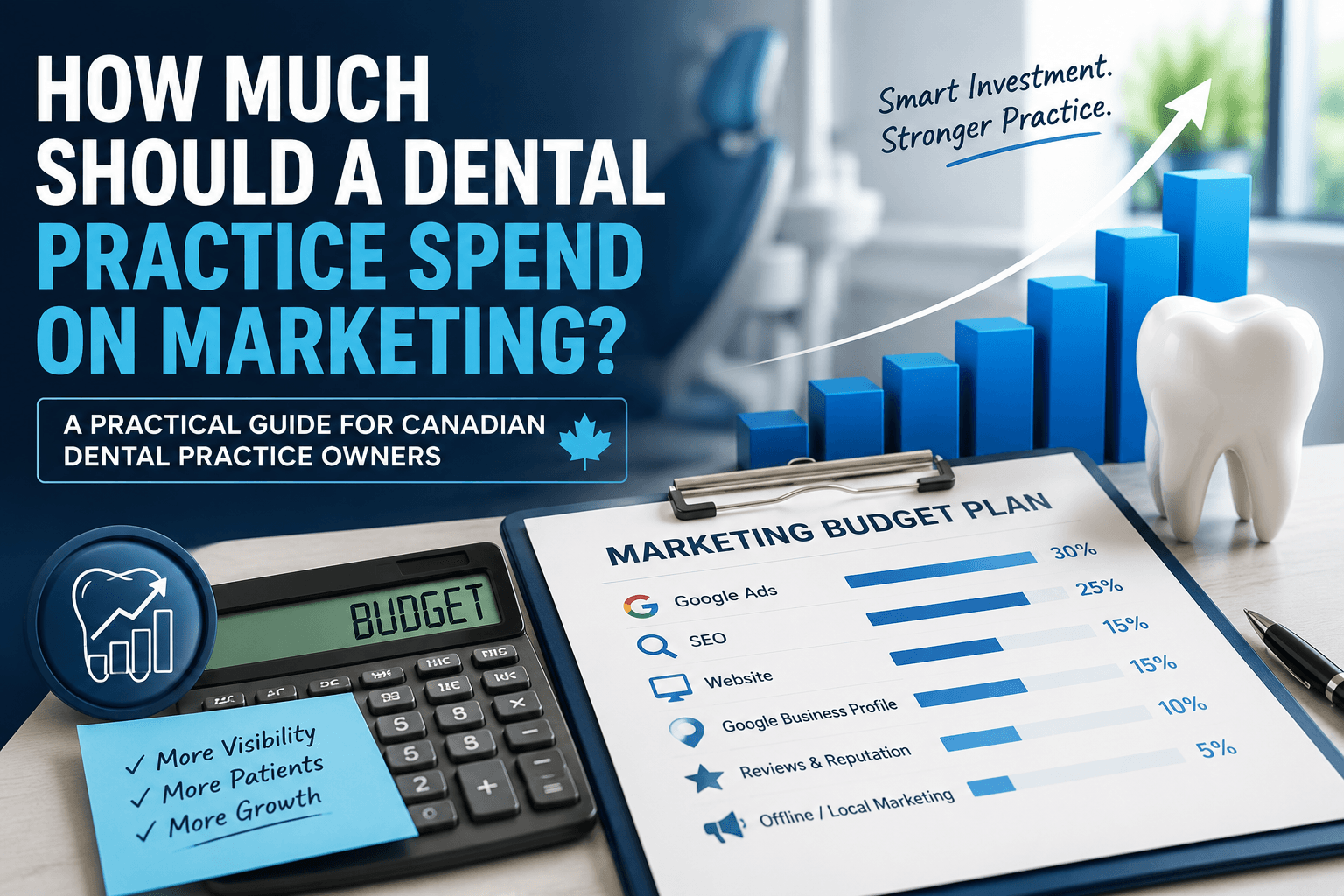
For most Canadian dental practices, a reasonable marketing budget falls between 3% and 8% of annual gross revenue. A newer practice in a competitive market will sit closer to the higher end. An established clinic with strong word-of-mouth and a stable patient base can often operate near the lower end.
That said, the percentage is a starting point, not a final answer. It misses critical variables that affect how much you actually need to spend.
Practice age matters. A clinic open for less than two years has not yet built the referral network, reviews, or local reputation that older practices rely on. Early-stage practices typically need to spend more to generate awareness before organic growth begins to carry its own weight.
Location shapes competitive pressure. A dental practice in a mid-sized Ontario city is operating in a very different environment from one in a downtown Vancouver corridor with ten competing clinics nearby. Urban markets with high competition require more visibility budget just to hold position.
Population growth around your clinic changes the math too. A practice near a newly developed residential area has a natural acquisition opportunity that an established neighbourhood without turnover does not. Capturing that opportunity costs money, and waiting too long to act means competitors do it first.
Budget Ranges by Practice Stage
The table below gives conservative, realistic ranges for Canadian dental practices. These are meant to guide planning, not guarantee outcomes. Results depend heavily on channel mix, execution quality, and how well tracking is set up.
Practice Situation | Suggested Annual Budget Range | Key Priority |
|---|---|---|
New practice (0–2 years) | $30,000 – $60,000+ | Brand awareness, Google presence, local outreach |
Growing practice (2–5 years) | $20,000 – $45,000 | SEO, paid search, reviews, retention |
Established practice (5+ years, stable) | $12,000 – $25,000 | Visibility maintenance, referrals, seasonal campaigns |
Multi-location or expansion phase | $50,000 – $100,000+ | Location-specific targeting, paid ads, content |
High-competition urban market | Add 20–40% to any stage above | Competitive SEO, Google Ads |
These figures assume a mix of digital and, where appropriate, offline activity. Consistently under-budgeting leads to the same outcome: slow or declining new patient flow that compounds over time and becomes harder to reverse.
How to Think About ROI: Patient Lifetime Value
One of the most common mistakes we see practice owners make is judging a marketing channel by the cost of the first appointment it generates. That framing significantly undersells the actual return.
Think about it this way. A new patient who books a cleaning, returns twice a year, eventually needs a crown, refers a family member, and stays with your practice for a decade is not a $250 patient.
Depending on your fee schedule and services, that patient may represent $8,000 to $15,000 or more in lifetime revenue.
The average lifetime value of a Canadian dental patient at between $8,000 and $12,000, though this varies based on location, services offered, and how well the practice retains patients.
When you view marketing through this lens, spending $200 to acquire a patient with an expected lifetime value of $10,000 looks very different. It stops being an expense and starts being a high-return investment.
This is also why patient retention deserves its own budget line. Keeping an existing patient active costs far less than acquiring a new one, and retained patients compound your lifetime value numbers year over year.
"The practices that grow consistently are usually not the ones spending the most on marketing. They're the ones who know what a patient is actually worth over time and build their budget around that number."
Which Channels Deserve Budget
Google and Local Search
For most practices, Google is where new patients start. Searches like "dentist near me" or "dental clinic [city]" capture people who are already ready to book. Google Business Profile optimization, local SEO, and Google Ads consistently deliver among the highest returns for dental practices because the intent behind those searches is immediate.
In competitive markets like Toronto, Calgary, or Vancouver, organic SEO alone often is not enough. A modest paid search budget layered on top of strong SEO is frequently what separates practices that fill their schedules from those wondering where new patients went.
Your Website
Spending money to drive traffic to a slow, hard-to-navigate, or outdated website is a recurring problem. Your site is not a brochure. It is where a potential patient decides whether to book or move on. Budget needs to account for keeping it functional, current, and conversion-focused, not just building it once and forgetting it.
Reviews and Reputation
Canadian patients read Google reviews before booking. A practice with fewer than 30 reviews, or an unaddressed negative review sitting near the top, will lose patients to a competitor that simply looks more trusted online. Asking patients to leave reviews and responding to what comes in is low-cost and high-impact. The effort is small. The effect on new patient decisions is not.