
Most dental clinics look at website form submissions as simple admin tasks.
A patient fills out a contact form. The front desk calls them back. Maybe they book. Maybe they do not.
But when you step back and analyze the actual patterns inside those submissions, something becomes very clear: dental website leads are not just “form fills.” They are patient intent signals.
They show what people are worried about. They show when patients are most likely to act. They show how often cost, insurance, pain, scheduling, and anxiety influence the decision to book.
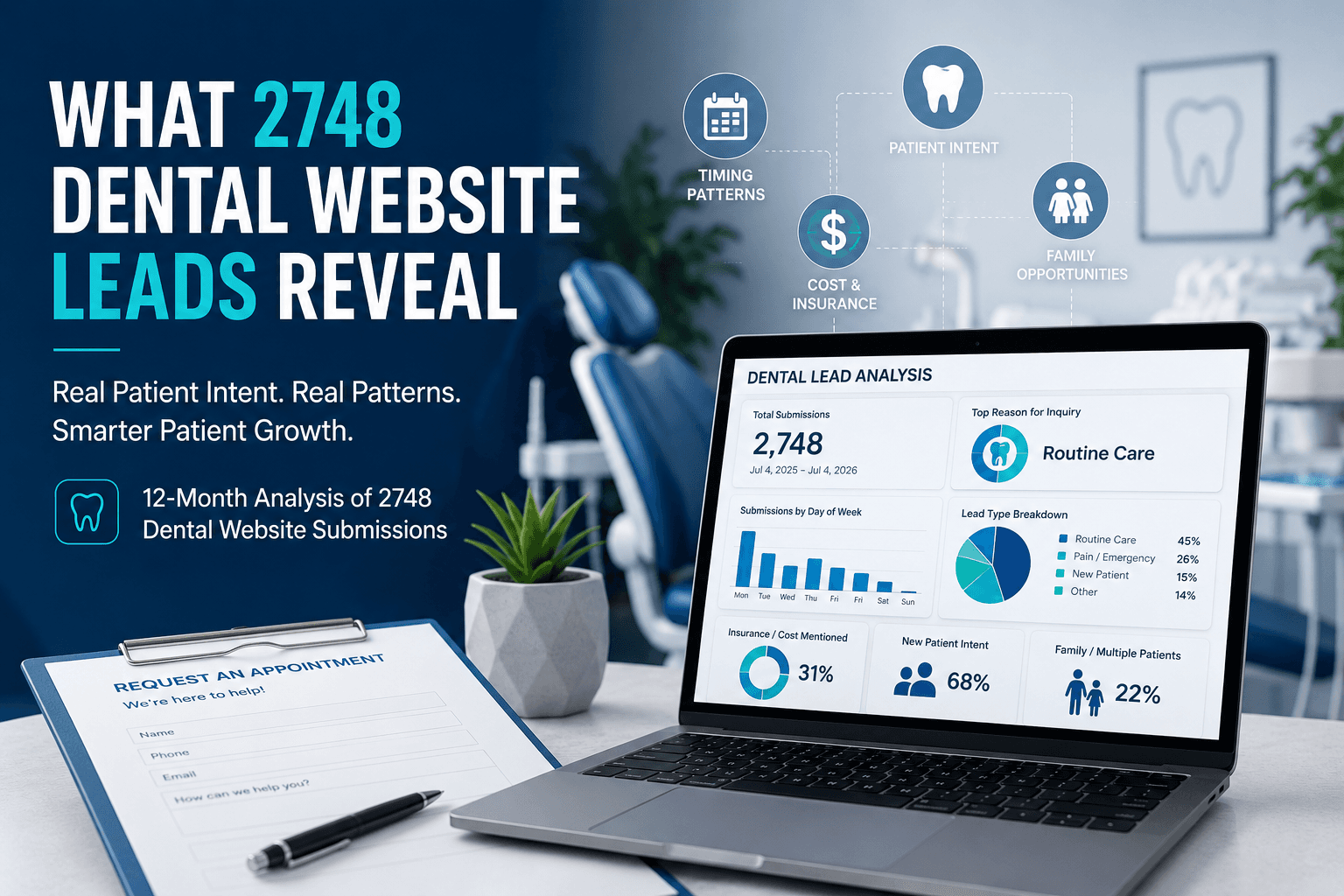
At North Media, we analyzed 2748 dental website lead submissions collected between July 4, 2025 and July 4, 2026 across multiple dental clinic websites.
This was not a clinical study. It was not meant to represent every dental patient in Canada. It was a practical marketing analysis of real website inquiries from dental practices.
But the patterns were strong enough that I believe every dentist should pay attention.
“Many clinics already have valuable patient intent coming through their website but the follow-up system, form design, and front desk workflow often decide whether that lead becomes a booked appointment.”
The biggest lesson?
Your website contact form is not just a contact form. It is part of your patient acquisition system.
About the Data
This analysis reviewed 2748 dental website lead submissions from several dental lead forms over a 12-month period.
The submissions came from contact forms, appointment request forms, popup forms, and service-related website forms.
To protect privacy, no patient names, phone numbers, emails, addresses, or personal details are included in this article. The findings below are based only on aggregated patterns.
The forms included a mix of general family dental clinics and one more specialized biological/holistic dental clinic. That gave us a useful view of both general patient behaviour and more specific treatment-driven demand.
The analysis looked at patterns such as:
Common reasons for inquiry
New patient intent
Emergency and pain-related language
Scheduling preferences
Insurance and cost concerns
Family booking opportunities
Website and form friction
Front desk conversion risks
Because this is form-submission data, it has limitations. It does not include phone calls, walk-ins, live chat inquiries, ad platform data, or final booked appointment outcomes. It also relies on what patients chose to write in a form, which may not fully reflect their actual clinical need.
Still, the data gives a valuable window into how patients behave before they book.
1. Monday Is a Major Dental Lead Opportunity
One of the most interesting timing patterns was the strength of Monday submissions.
Across several forms, Monday was one of the busiest days for patient inquiries. Tuesday and Wednesday also showed strong activity in some cases, but Monday stood out repeatedly.
This makes sense.
Patients may experience pain or worry over the weekend. They may delay booking until the start of the workweek. Parents may use Sunday night or Monday morning to plan appointments. People who could not reach the office over the weekend may submit a form and wait for a response.
This creates a very practical opportunity for dental practices.
Monday morning should not be treated like a normal admin period. It should be treated like a conversion window.
The clinic should know:
How many forms came in over the weekend
Which ones mention pain or urgency
Which ones are new patients
Which ones requested specific appointment times
Which ones asked about insurance
Which ones are family bookings
If a clinic starts Monday by working through old voicemails, inbox clutter, and general admin before responding to new patient inquiries, some of those leads may already be gone.
A better system is to have a Monday morning lead review process.
Even a simple workflow can help:
Check all weekend form submissions.
Flag emergency or pain-related inquiries first.
Respond to new patient inquiries quickly.
Text or email patients who requested non-phone communication.
Follow up again later in the day if there is no response.
This is not complicated. But it requires consistency.
2. Routine Care Is the Most Common Entry Point
Across the forms analyzed, routine dental care was one of the most common reasons people reached out.
Patients frequently asked for:
Cleaning
Checkup
Exam
Scaling
Annual or biannual appointments
New patient exams
Family cleanings
From a growth perspective, routine care is extremely important because it is often the front door to a long-term patient relationship.
A new patient who books for a cleaning may later need restorative work. A parent booking their own appointment may also book their children. A patient who has not been to the dentist for several years may start with “just a cleaning” but require a more comprehensive treatment plan after the exam.
The cleaning is often the beginning of the relationship.
For dental marketing, this also means service pages and calls-to-action should not only focus on high-ticket treatments. Yes, implants, Invisalign, veneers, and emergency dentistry matter. But many people still enter through basic preventive care.
A strong dental website should make routine booking feel easy, reassuring, and low-friction.
3. Pain-Based Leads Need Immediate Triage
Another clear pattern was the presence of urgent language.
Patients used terms related to:
Tooth pain
Swelling
Abscess concerns
Broken teeth
Cracked teeth
Sensitivity
Bleeding
Broken fillings
Crowns that came off
Trouble eating
Trouble sleeping
“ASAP” or “urgent”
These submissions should not be treated like general inquiries.
A person asking about a future cleaning and a person describing pain or swelling are in very different situations. Yet in many clinics, both submissions may land in the same inbox.
That creates a conversion risk.
Pain-based leads are often actively looking for help. If one clinic does not respond quickly, the patient may contact the next clinic on Google.
For dentists, the takeaway is simple: your website form should help the front desk identify urgency immediately.
A better form might include a dropdown such as:
“What best describes your request?”
Options could include:
Cleaning or checkup
Dental emergency or pain
Broken tooth or filling
Cosmetic consultation
Invisalign or braces
Insurance or billing question
Booking for a family member
Other
Even better, the clinic can set up internal alerts for words like pain, swelling, broken, abscess, urgent, ASAP, bleeding, cracked, infection, or cannot eat.
The faster these leads are identified, the faster the team can respond.
4. After-Hours Leads Are More Common Than Many Clinics Expect
Another major pattern was that patients often submit forms outside regular clinic hours.
Some inquiries came in during evenings, weekends, early mornings, and late nights.
This matters because most dental clinics think of their front desk as the first point of contact.
But for many patients, the website is the first point of contact.
The website is open when the clinic is closed. The form is available when the phone is not answered.
If the form feels unclear, too long, hard to use on mobile, or gives no confirmation, the clinic may lose trust before the first conversation.
At minimum, every dental website form should trigger an immediate confirmation message.
Something like:
“Thank you. We received your request. If you are experiencing dental pain or swelling, our team will review your message as soon as possible during business hours. If this is a medical emergency, please call 911 or seek urgent care.”
For non-emergency lead conversion, even a simple automated text or email can make a difference. It tells the patient their message did not disappear.
After-hours lead capture is not just a marketing issue. It is a trust issue.
5. Insurance and Cost Questions Are a Major Conversion Factor
A major theme across the submissions was financial clarity.
Patients asked about or mentioned:
Canadian Dental Care Plan
NIHB
AISH
Alberta Seniors Dental Assistance
Alberta fee guide
Direct billing
SunLife
Blue Cross
Canada Life
Manulife
Estimates
Out-of-pocket costs
This should not surprise dental clinics.
Dental care can be a significant household expense, and many patients want to understand coverage before they commit to an appointment.
The Canadian Dental Care Plan is also now part of the patient conversation. The Government of Canada describes the CDCP as a program designed to help make dental care more affordable for eligible Canadian residents, and Canada.ca lists information for patients and providers, including covered services and provider participation details.
For dental websites, this creates a clear content opportunity. For example, you can embed our free CDCP eligibility & co-pay calculator on your website.
Clinics do not need to promise exact coverage online. In fact, they should avoid making overly broad claims because coverage depends on the patient, plan, procedure, eligibility, and preauthorization rules.
But they can still reduce uncertainty.
A strong dental website should have an insurance/payment section that answers questions like:
Do you offer direct billing?
Do you accept CDCP patients?
Do you help patients understand their estimate?
Which major insurance plans do patients commonly ask about?
What should a patient bring to their first visit?
Will the clinic explain out-of-pocket costs before treatment?
Patients are not only comparing clinical skill. They are also comparing how easy it feels to move forward.
Financial confusion creates friction. Clarity creates confidence.
6. New Residents Are Actively Looking for Dental Homes
Another recurring pattern was patients saying they had recently moved.
Some were new to the city. Some had moved from another province. Some had moved to a new neighbourhood and wanted a clinic closer to home. Others were looking for a better fit after leaving a previous provider.
This is a major local SEO opportunity.