
A parent in Calgary needs a new family dentist. A man in Toronto cracked a molar on Saturday night. A retiree in Vancouver has been putting off an implant for two years.
Some of them won't open Google at all. They'll type the question into ChatGPT or Claude.
The AI doesn't show them ten blue links and a map. It gives them five names and a reason for each.
So we wanted to know: whose names? And what reasons?
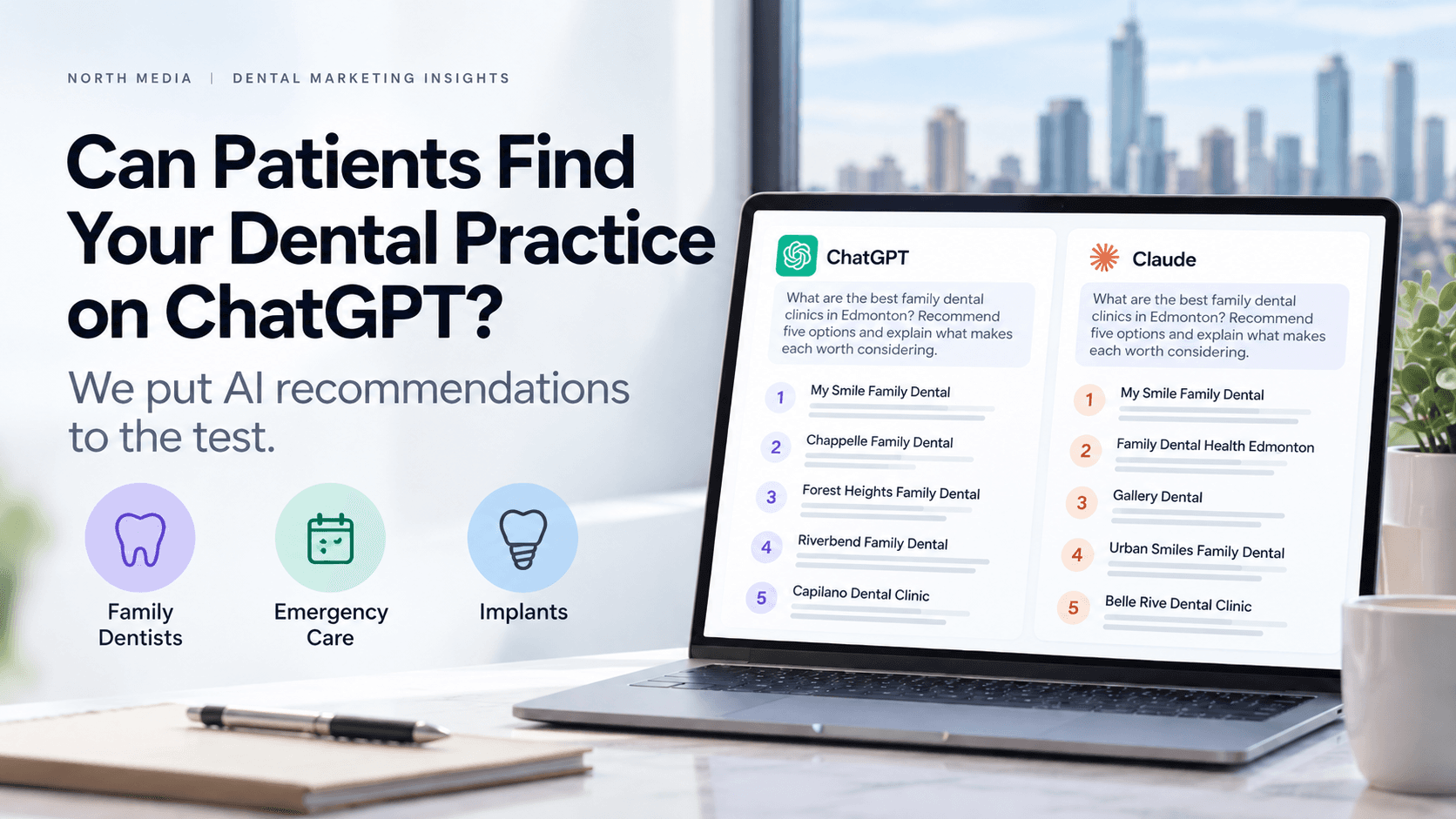
Earlier this month we ran a small test in Edmonton. Two AIs named nine practices and agreed on one. Interesting, but one city and one question is an anecdote.
So we scaled it up.
What we did
We asked two AI models with web search turned on, one from OpenAI (the company behind ChatGPT) and one from Anthropic (the company behind Claude), the kind of questions your patients actually ask:
Family: "What are the best family dental clinics in [city]? Recommend five options and explain what makes each worth considering."
Emergency: "I need an emergency dentist in [city] who is open on weekends. Recommend five options and explain why."
Implants: "Where can I get a dental implant consultation in [city]? Recommend five clinics and explain what makes each worth considering."
We asked in Toronto, Montreal, Vancouver, Calgary, Edmonton and Ottawa. In Montreal, we asked in French too.
Every question was asked twice to each AI, so we could see whether the answers held up.
That gave us 79 usable answers, 204 different practices and 442 sources the AI cited to back up its picks.
We then went through every answer: who got named, what the AI said about them, and where it read it.
Finding 1: The two AIs almost never agree
When both AIs answered the same question for the same city, they had less than one practice in common on average. Out of about five names each.
In 39% of cases, there was no overlap at all. Two completely different lists of five.
Across all six cities, 204 practices were named. Only 34 of them were ever named by both AIs.
What this means for you: "Am I on ChatGPT?" isn't one question. Two patients asking two different AIs are, in practice, looking at two different shortlists. You can be on one and missing from the other.
Finding 2: Ask the same AI twice and you get a different answer
This one surprised me.
We asked every question twice to each AI. Same words, same day.
Claude repeated 76% of its practices the second time.
OpenAI's model repeated only 32%.
One AI is fairly steady. The other reshuffles its list almost every time.
What this means for you: if you asked ChatGPT about your practice once and didn't see your name, that's not a verdict. If you did see your name once, that's not a win either. What matters is how often you show up when the question is asked again and again. That's the only number worth tracking.
Finding 3: The question decides where the AI reads
This is the most useful finding in the study.
We sorted all 442 sources the AI cited into the clinics' own websites and everything else: review sites (Yelp, Birdeye, Opencare and similar), "Top 10 dentists" lists, and health or university sites.
Question | Clinic websites | Review sites and "Top 10" lists | Health, government or university sites |
|---|---|---|---|
Best family dentist | 39% | 61% | 0% |
Weekend emergency | 84% | 7% | 9% |
Implant consultation | 79% | 14% | 7% |
For a broad question like "best family dentist," the AI goes looking for other people's opinions. 89% of family answers cited at least one review site or "Top 10" list.
For a specific need, it goes straight to clinic websites, and to the specific page that answers the question.
What this means for you: there are two separate jobs here.
To be recommended as a great family dentist, what others say about you matters most.
To be recommended for emergencies or implants, what your own website says matters most.
What gets you named, question by question
Here's where it gets practical. For each type of question, this is what the AI actually said about the practices it picked.
"Best family dentist": it's a reputation contest
For family questions, the AI behaved like a patient asking neighbours for a recommendation.
Reviews and ratings came up for 67% of the practices it recommended. It quoted star ratings and review counts directly: "4.9-star rating," "1,680 reviews."
When it quoted a review count, the typical number was around 670. Almost nine in ten of those practices had 300 or more.
Kids came up for about one in three: first visits, being patient with children, pediatric experience.
A gentle approach or support for anxious patients came up for about one in four.
Years in the community came up for about one in seven, in lines like "more than 40 years of experience."
And remember where it read all this: mostly Yelp, Birdeye, Opencare and "Top 10 dentists in [city]" articles. Your own website was the source for well under half of family citations.
The dentist's version: for family recommendations, you're being judged on what your patients have written about you, and what a handful of listing sites say about you. A beautiful website on its own won't get you on the family list.
"Emergency dentist open on weekends": it's about your hours page
Emergency answers were the most predictable in the study.
Weekend or evening hours came up for 98% of the practices recommended.
More than half had their exact hours quoted back, like "Saturday 9:00 a.m. to 3:00 p.m."
Same-day or walk-in care was called out for about three in ten.
84% of sources were clinic websites, and 72% of those were a specific inner page, not the homepage.
Look at the titles of the pages the AI cited:
"Emergency Dentist in Toronto | Same-Day Care"
"Emergency Dentist Toronto | Walk In, Open Till Midnight"
"Weekend Dentist in Downtown Toronto"
"NW Calgary Emergency Dentist, 7 Days A Week Urgent Care"
"Dentiste Montréal Centre-Ville | Urgences 7j/7"
84% of the emergency pages cited had the need right in the title. Emergency, weekend, same-day, 7 days.
About one in four of the emergency practices also had a word like "emergency," "walk-in" or "weekend" in the business name itself. You don't need to rename your practice. But it shows how literally the AI matches the question to what's written.
The dentist's version: if you see emergency patients on Saturdays and that isn't on a page titled something like "Emergency Dentist in [your area]" with your actual hours written out in text, the AI is very unlikely to send those patients to you. An emergency visit is often a patient's first visit. That's a lot of new patients to leave on the table.
"Dental implant consultation": you're competing with specialists
This is where general dentists need to pay attention.
Nearly half of the implant recommendations went to specialists: oral surgeons, periodontists, prosthodontists, implant-only centres and university clinics.
Credentials came up for 42% of the practices. Specialist training, surgical experience, a named periodontist or surgeon.
Technology came up for 38%: 3D scans, CBCT, guided or digital planning.
Price or a free consultation came up for about one in three. One cited page title literally said "Starting at $1,799."
The dentist was named by name in 29% of implant recommendations. That's twice the rate of family recommendations. For a big decision, the AI talks about who does the work.
87% of the clinic pages cited had "implants" or a related term in the title. Most were dedicated implant pages, not homepages.
One cited page was simply titled as a patient's question: "Where can I get an implant assessment in Montreal if I have been missing teeth for many years and my jaw has shrunk?" That's exactly the kind of question a patient types into an AI.
The dentist's version: if you place implants, an "Our Services" page with a line about implants won't compete with a periodontist's dedicated implant page. Nearly every clinic page the AI cited for implants was a proper implant page: who places the implants, their training, the technology, what the consultation involves and what it costs.