
If you’re opening, buying or growing a dental practice in Edmonton, some parts of the city are considerably harder to compete in than others.
And I don't mean simply because there are more dental offices.
In August 2026, we analyzed 3,380 Google Maps results across 169 locations in and around Edmonton for the search term “dentist.”
Our first study showed something surprising:
94 different businesses ranked #1 somewhere.
This time, I wanted to answer a question I think is even more useful for a practice owner:
Where in Edmonton is the dental market actually the most competitive?
To answer that properly, I looked at two sides of competition:
How crowded and fragmented the Google Maps results are
and
How established the practices you're competing against already are.
Because there's a big difference between entering a market where the surrounding practices have 80 reviews and entering one where some of the practices patients see have 500, 1,000 or even more reviews.
Here’s what the data showed.
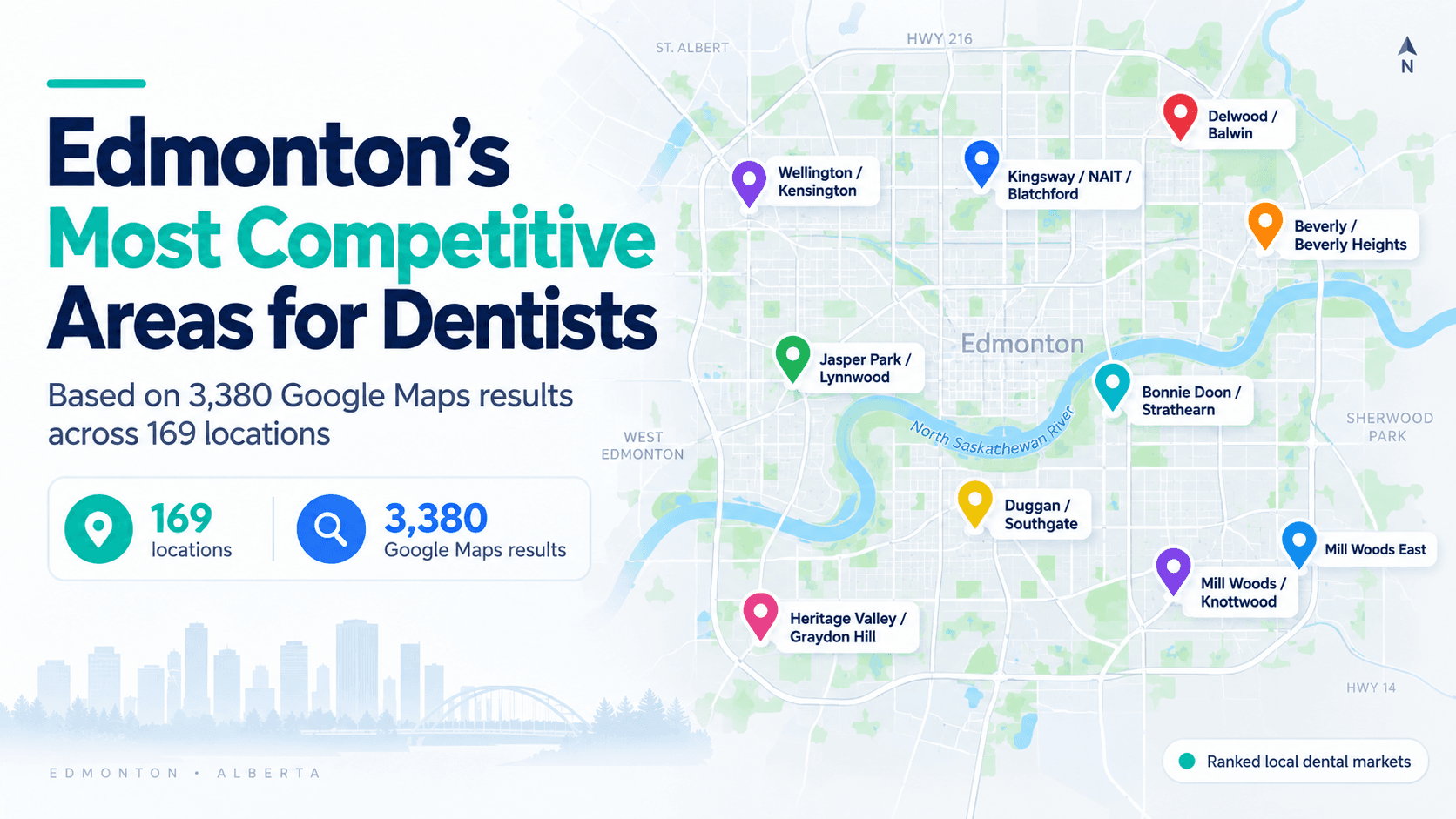
The Most Competitive Edmonton Areas for Dentists
Based on the local Google Maps competition observed in our 169-location study, these were some of the toughest local dental search markets we found:
Rank | Edmonton Area | Different Clinics in Top 3 | Different Clinics in Top 10 |
|---|---|---|---|
1 | Duggan / Southgate | 27 | 74 |
2 | Mill Woods / Knottwood | 27 | 72 |
3 | Delwood / Balwin | 26 | 65 |
4 | Kingsway / NAIT / Blatchford | 25 | 65 |
5 | Wellington / Kensington | 25 | 64 |
6 | Heritage Valley / Graydon Hill | 26 | 58 |
7 | Bonnie Doon / Strathearn | 23 | 64 |
8 | Jasper Park / Lynnwood | 22 | 71 |
9 | Beverly / Beverly Heights | 23 | 58 |
10 | Mill Woods East | 23 | 58 |
These are local dental search markets, not official City of Edmonton neighbourhood boundaries.
For each area, we analyzed a nine-point local search window around that portion of the city and measured how many different dental practices entered Google's strongest positions.
And the amount of turnover was much higher than I expected.
First, What Do I Mean by “Competitive”?
This is important.
I would not call an area competitive simply because it has 15 dental offices nearby.
Imagine two markets.
Market A
Twenty-five practices regularly enter the Google results.
But most of the established clinics have relatively modest online profiles.
Market B
Only 15 practices regularly compete.
But several have hundreds of patient reviews, strong Google visibility and years of accumulated reputation.
If you're opening a new dental clinic with:
0 reviews
0 local history
0 existing Google visibility
Market B could easily feel harder to penetrate.
So when I think about dental-market competition, I think about two things.
1. Search Competition
How many different practices are fighting for Google's strongest positions?
We measured:
#1 turnover
Top-three fragmentation
Top-10 fragmentation
2. Competitor Strength
How established are the practices a patient sees beside you?
Reviews matter here for two reasons.
First, Google itself identifies reviews and positive ratings as factors that can contribute to local prominence.
Second, and perhaps more importantly from a business perspective, patients see those reviews.
A brand-new practice with 17 reviews appearing beside a clinic with 700 reviews has a very different trust challenge.
I therefore treat reviews as part of the competitive environment, not as proof that reviews alone caused a practice to rank.
#1. Duggan / Southgate: The Most Fragmented Market We Found
The local search market around Duggan and Southgate produced the highest level of overall Google Maps fragmentation in our analysis.
Across nine nearby search locations:
9 different businesses ranked #1
27 different businesses appeared in the top three
74 different businesses appeared somewhere in the top 10
That second number is the one that caught my attention.
There are exactly:
9 search locations × 3 top positions = 27 available top-three positions.
And we saw:
27 different Google Business Profiles occupy those 27 positions.
Not one practice repeated in the top three across that particular nine-point window.
That is an incredibly fluid local-search market.
Move the patient a relatively short distance and the businesses Google considers strongest can change completely.
For an established practice in this part of Edmonton, that means being “#2 for dentist” from your office tells you surprisingly little about your overall market.
For a new practice, it means you are entering a search environment where a large number of clinics are capable of competing for prime visibility.
We also see established profiles in and around this broader south-central market with hundreds of patient reviews. For example, Whitemud Dental Centre currently shows roughly 293 reviews, while Pearly Dental in the broader south Edmonton/Mill Woods competitive set shows more than 400. Whitemud Dental Centre South Edmonton Pearly Dental Mill Woods
That reputation layer matters when you're trying to win not just the ranking, but the patient.
#2. Mill Woods / Knottwood: Crowded Search Results + Established Competitors
Mill Woods was almost as fragmented.
Across the local window around Mill Woods / Knottwood, we found:
9 different #1 businesses
27 different top-three businesses
72 different businesses entering the top 10
Again:
Every available top-three position across the nine searches was occupied by a different practice.
But Mill Woods becomes especially interesting when you look beyond ranking turnover.
Some of the practices competing in and around southeast Edmonton have substantial review profiles.
Mill Woods Town Centre Dental Clinic, for example, currently displays 637 Google reviews and a 4.8 average rating on its own website.
Orchards Dental, which showed unusually broad visibility in our original Edmonton dataset, has approximately 1,400 Google reviews according to current third-party review aggregation data.
That creates a very different competitive environment for a new clinic.
You're not just asking:
“Can I rank?”
You're also asking:
“If I do rank, will a patient choose me when established clinics beside me have hundreds or more than a thousand reviews?”
That's why I consider Mill Woods one of Edmonton's toughest overall dental markets.
#3. Delwood / Balwin: North Edmonton Is Not an Easy Market Either
The Delwood / Balwin area produced:
9 different #1 businesses
26 different practices in the top three
65 different practices in the top 10
Only one top-three position repeated across the entire nine-search window.
That is still an extremely fragmented result set.
And there is another factor working against a brand-new entrant:
established reputation.
The Dentists at Northgate, for example, currently displays 1,888 reviews on its website alongside a 4.6 average rating.
Think about that from the perspective of a new dental owner.
You could do everything right:
build a beautiful clinic
create a great website
run Google Ads
optimize your Business Profile
start generating reviews
and still be appearing on the same search-result screen as a practice with nearly 1,900 existing reviews.
That doesn't mean a new practice cannot compete.
It means the strategy needs to account for the starting gap.
#4. Kingsway / NAIT / Blatchford
The area around Kingsway, NAIT and Blatchford showed:
9 different businesses ranking #1
25 different practices entering the top three
65 different practices entering the top 10
This is another highly fragmented central/north-central search environment.
It's also a useful reminder that your Google competitors aren't necessarily limited to clinics physically inside one neighbourhood.
Practices from surrounding areas can still enter the results.
So if you're evaluating a location for a dental clinic, simply counting the practices within a one-kilometre circle won't necessarily tell you who you're actually going to compete against online.
Google competition travels.
#5. Wellington / Kensington
Around Wellington / Kensington, we observed:
9 different #1 practices
25 different top-three practices
64 different top-10 practices