All articles
Invisalign & OrthoJune 14, 20265 min read

Invisalign Marketing for Dental Practices: What Drives New Patients

Learn how dental practices can market Invisalign effectively using local SEO, Google Ads, reviews, and content that converts high-intent patients.

invisalign marketing for dental practices in Canada

Invisalign marketing works when it reaches patients who are already searching for clear aligner treatment and gives them a fast, clear reason to choose your practice.

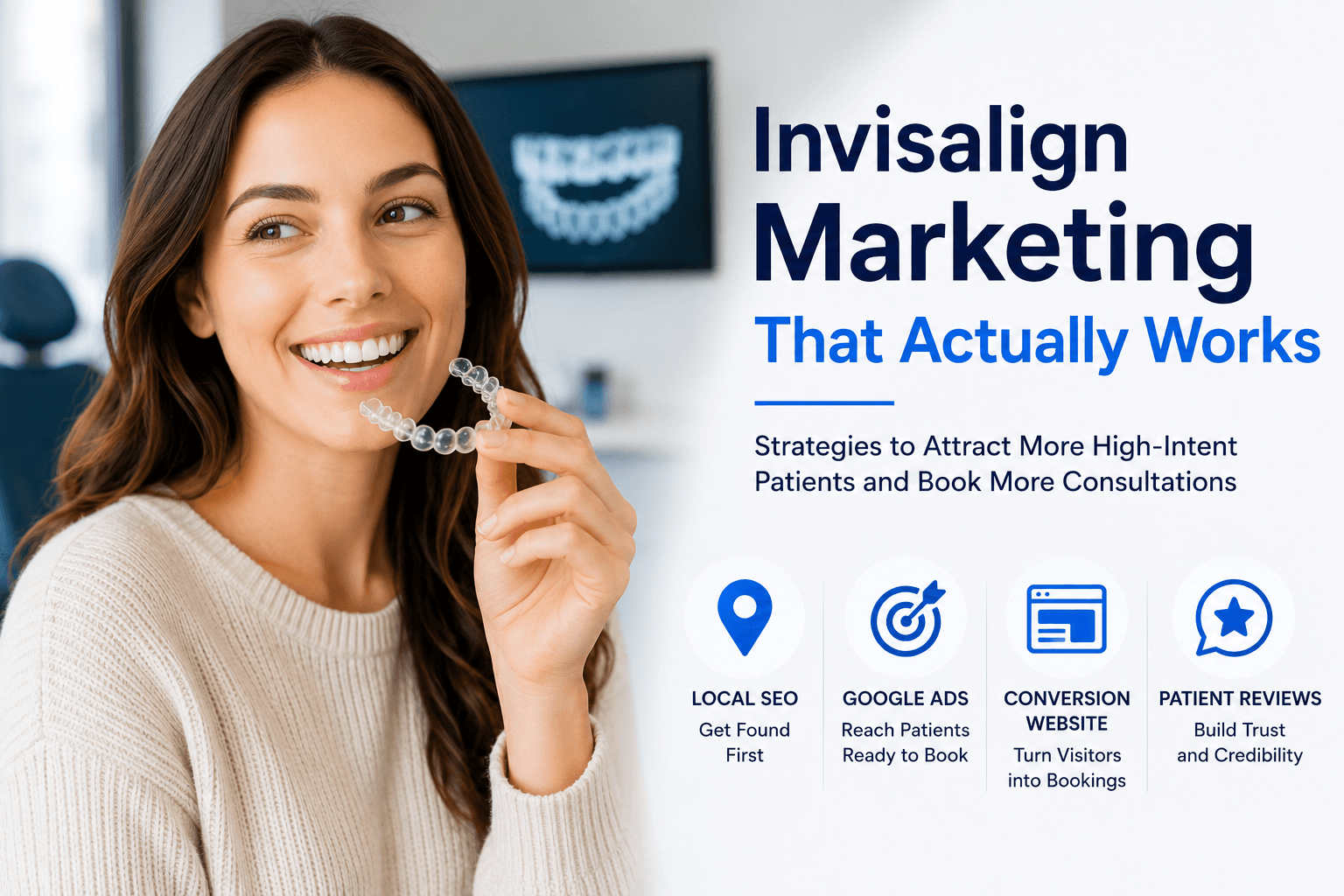
The channels that consistently drive results are local SEO, Google Ads, a conversion-ready website, and a steady flow of patient reviews. Generic "smile transformation" messaging does not move the needle. Intent-matched, location-specific content does.

If you offer Invisalign, the marketing objective is straightforward: show up when patients search, give them enough information to trust you, and make it easy to book. Here is exactly how to do that.

Why Invisalign Is Worth Prioritizing in Your Marketing

Invisalign patients tend to be adults who have already decided they want treatment. They are not being sold on the idea of straighter teeth. They are comparing providers. That distinction changes how you should approach your marketing.

The average Invisalign case generates between $3,000 and $8,000 in revenue depending on case complexity and your market. According to Align Technology's latest annual report, over 15 million patients have been treated with Invisalign globally, with case volume continuing to grow year over year. That demand is real, measurable, and searchable.

Because patients are actively comparing options, your marketing needs to accomplish two things: get you found first, and convert that visibility into booked consultations.

The Four Core Channels for Invisalign Patient Acquisition

1. Local SEO: How Does Invisalign Search Traffic Actually Work?

Most Invisalign patients start with a Google search. Common queries include "Invisalign near me," "clear aligners [city name]," and "how much does Invisalign cost." Your practice needs to rank for these terms in your specific market.

Local SEO for Invisalign requires three things working together:

  • A dedicated Invisalign service page with location-specific content, cost information, and clear calls to action

  • A fully optimized Google Business Profile with Invisalign listed as a service, recent photos, and active review management

  • Local citations and backlinks that confirm your practice's authority in your area

A standalone Invisalign page consistently outperforms a general orthodontics page for these search terms. Google's Search Quality Evaluator Guidelines place significant weight on expertise, authoritativeness, and trustworthiness. A page that directly addresses patient questions about cost, treatment duration, and candidacy signals all three.

2. Google Ads: The Fastest Path to High-Intent Patients

Paid search is the fastest way to get in front of Invisalign patients who are ready to book. Unlike SEO, which builds over months, Google Ads campaigns targeting Invisalign keywords can generate appointment requests within days of launch.

Effective Invisalign ad campaigns focus on:

  • Keywords with booking intent such as "Invisalign consultation," "Invisalign provider near me," and "affordable Invisalign [city]"

  • Ad copy that leads with a specific differentiator such as a free consultation, flexible financing, or same-week availability

  • Landing pages that match the ad message exactly and include a prominent booking form above the fold

Cost-per-click for Invisalign terms can range from $8 to $25 depending on market competition. That is meaningful spend. Your landing page conversion rate directly determines whether ads are profitable. A page converting at 2% versus 8% changes your cost per acquired patient significantly.

3. Website Conversion: What Should an Invisalign Page Actually Include?

Traffic without conversion is wasted spend. Your Invisalign page needs to answer the questions patients are genuinely asking before they will book a consultation.

The most common questions patients research before choosing a provider:

  • How much does Invisalign cost?

  • Am I a good candidate?

  • How long does treatment take?

  • Does Invisalign hurt?

  • What is the difference between Invisalign and braces?

Address all of these directly on your service page. According to a survey by the American Association of Orthodontists, cost transparency consistently ranks among the top factors patients consider when selecting a provider. Avoiding the cost question does not make patients less price-sensitive. It sends them to a competitor who will answer it.

Page elements that improve consultation bookings:

  • A visible phone number and booking button in the first screen

  • Before-and-after photos with patient consent

  • Verified Google reviews embedded or linked on the page

  • A short video introduction from the treating dentist

  • Financing options with monthly payment estimates stated clearly

"When patients land on a practice's Invisalign page, they're essentially doing a final check before deciding whether to call," says Sriram, founder of North Media. "If the page doesn't answer the cost question or show real results, most of them leave without booking."


4. Reviews: The Proof Point Patients Trust Most

Invisalign is a considered purchase. Patients spend weeks or months researching before committing. Reviews are the most credible proof point your practice has.

Google reviews affect both local search ranking and patient decision-making. A BrightLocal Consumer Review Survey found that 98% of consumers read online reviews for local businesses, with dental practices ranking among the top categories where reviews directly influence choice.

A structured review generation process matters more than a one-time push. After each Invisalign consultation or case start, your front desk or automated follow-up system should prompt the patient to leave a Google review. Practices that do this consistently build the review counts that signal credibility to both patients and Google.

"Reviews aren't just a trust signal for patients," notes Sriram. "They're one of the clearest signals Google uses to determine which practices show up in the local pack for high-value searches like Invisalign."

Invisalign Marketing Mistakes That Waste Budget

These are the most common errors practice owners make when marketing Invisalign:

  • Sending ad traffic to the homepage instead of a dedicated landing page

  • Using stock photography instead of real patient photos, which reduces trust

  • Neglecting Google Business Profile optimization while spending heavily on paid ads

  • Publishing generic Invisalign content without location, cost range, or candidacy information

  • Failing to track which marketing channel is generating consultation bookings

Without tracking, you cannot determine what is working. At minimum, use call tracking numbers for each channel, UTM parameters on all ad links, and a simple intake question asking patients how they found you.

How to Measure What Is Actually Working

The metrics that matter for Invisalign marketing are straightforward:

  1. Organic rank for "Invisalign [city]"Whether your SEO is working

  2. Cost per consultation booked

  3. Whether your ad spend is efficient

  4. Consultation-to-case conversion rate

  5. Whether your team is closing effectively

  6. Review count and average rating

  7. Whether your trust signals are strong

  8. Bounce rate on the Invisalign page

  9. Whether your page content is relevant

Review these numbers monthly. If cost per consultation is rising, check whether your landing page conversion has dropped or whether competitor bids have increased. If organic rank is stagnant, audit your service page for content depth and local keyword usage.

How North Media Helps Practices Build Invisalign Marketing That Performs

North Media works specifically with dental practices to connect visibility, website performance, and patient acquisition into one measurable system. For Invisalign, that means identifying where your practice is losing ground, whether in search rankings, ad efficiency, or page conversion, and addressing the highest-impact gaps first.

If you want to understand where your Invisalign marketing stands right now, a focused audit is the fastest way to find out. Reach out to North Media for a clear picture of what is working and what is costing you patients.

Frequently Asked Questions

How much should a dental practice spend on Invisalign marketing?

Budget depends on your market size and competition. Most practices start seeing results with $1,500 to $3,000 per month in paid ads combined with ongoing SEO investment. A single Invisalign case typically recovers the monthly budget quickly when conversion is managed well.

Does Invisalign marketing require Align Technology's approval?

Align Technology provides a provider portal with co-op marketing materials and branding guidelines. Diamond and Platinum providers have access to additional marketing support. You must follow their branding standards in ads and on your website.

What is the fastest way to generate Invisalign consultations?

Google Ads targeting high-intent local keywords with a dedicated landing page is the fastest path. SEO builds durable long-term traffic but typically takes three to six months to show significant ranking movement.

How important is a Google Business Profile for Invisalign marketing?

Very important. Local pack results appear above organic listings for most "Invisalign near me" searches. A complete, actively managed Google Business Profile with strong reviews is essential for appearing in those results.

Should I create separate pages for Invisalign and clear aligners?

If you offer both Invisalign and other aligner brands, separate pages allow you to target brand-specific search terms more precisely. If you only offer Invisalign, one well-optimized page covering all related queries is sufficient.

Free, no-pressure strategy call

Want results like the practices we write about?

Book a free strategy call and we'll show you exactly how to turn search demand into booked new patients.

Book a Strategy Call

Short on time? Chat with a dental marketing expert, no booking required.