
You probably clicked a Facebook ad to get here. A marketing agency running an ad about why dentists don't trust marketing agencies. We get it.
The irony is real. We're not going to pretend otherwise.
Here's what we actually believe: your skepticism is earned. If you've worked with an agency before and felt like you were paying for activity instead of results, you weren't naive for trying. The problem isn't you. It's structural, and it's worth understanding before you make another decision.
Why the Burnout Pattern Keeps Repeating
The dental marketing space has a scaling problem most agencies won't say out loud.
When an agency grows quickly, they hire junior staff to manage the overflow. Those staff work from templates. The same ad structure that ran for a clinic in Calgary gets recycled for one in Edmonton. The same Google Business Profile approach used for a personal injury lawyer gets applied to a general dentist. The person who sold you the service is rarely the person who runs your account by month two.
This isn't about bad intentions. It's what happens when a business model rewards signing new clients more than it rewards retaining them. Once you're on board, the urgency to impress you drops.
The result is familiar: strong first impressions, a lot of reporting on numbers that sound meaningful, and a quiet slide toward mediocrity by month four.
The Metrics That Sound Good but Mean Nothing
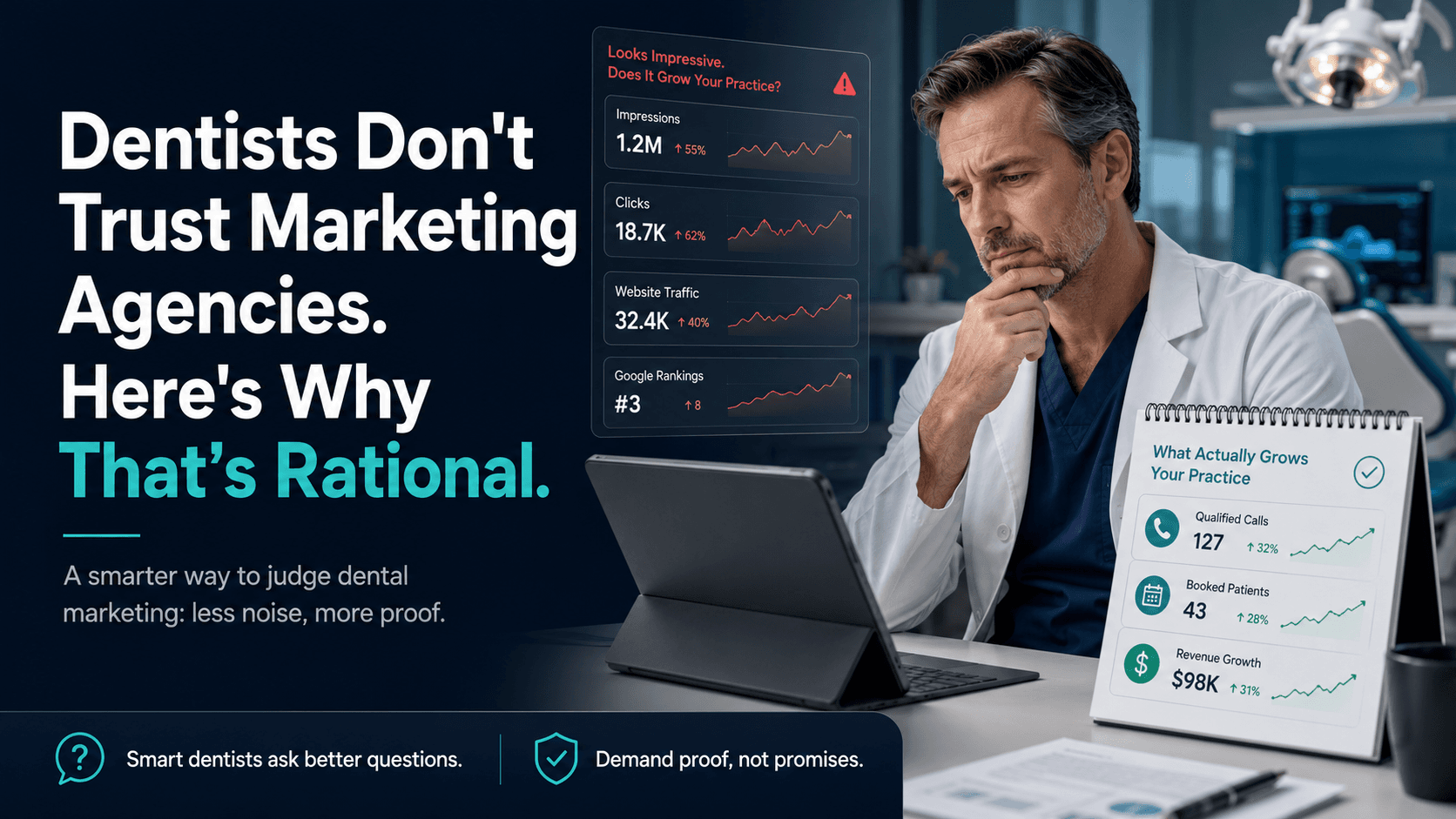
Reports full of impressions, clicks, reach, and cost-per-click are easy to produce. They're also easy to hide behind.
None of those numbers tell you whether a real person booked an appointment. An agency can hit every single benchmark in that report and still deliver zero growth to your practice.
The metric that connects marketing spend to actual practice growth is cost per booked appointment, tracked from the first ad click to the confirmed booking.
The average dental practice converts fewer than 50% of inbound leads into scheduled appointments, which means tracking clicks alone misses half the picture at minimum.
Everything else is context at best. At worst, it's a distraction dressed up in a slide deck.
If your current or past agency never built that tracking, that's not a detail they'll fix on the next call. It reflects how they're set up to operate.
What Specialization Actually Changes
There's a real difference between a generalist agency that adds dental clients to its roster and a team that works inside dental practices day in, day out.
A dental-specific agency understands that a patient searching "emergency dentist open now" needs a completely different response than someone browsing implant options on a Saturday afternoon. It knows that Google Business Profile visibility within 5-7 km kilometres of your clinic matters far more than broad national rankings. It understands why a cosmetic patient's decision cycle runs weeks or months longer, and why your website needs to support that process rather than just look good.
That knowledge doesn't come from a template library. It comes from repetition across real practices, real budgets, and real patient behaviour.
You Have No Reason to Trust Us Yet
We mean that directly.
Trust in a marketing partner should be built on what they show you, not what they claim in an article. In our conversations with practice owners across Canada, the ones who've been burned the hardest are usually the ones who were sold a package before anyone asked a single question about their practice.