AI search engines like ChatGPT, Google AI Overviews, and Perplexity pull answers directly from web content and present them to users without requiring a click. For optometrists, this changes how potential patients discover your practice.
Ranking in AI search means your practice name, services, or expertise gets cited when someone asks questions like “best optometrist near me for dry eye treatment” or “how often should I get an eye exam.”
This matters because AI-generated answers are becoming the first point of contact for many health-related searches. Practices that optimize for AI retrieval will capture attention before traditional search results even appear.
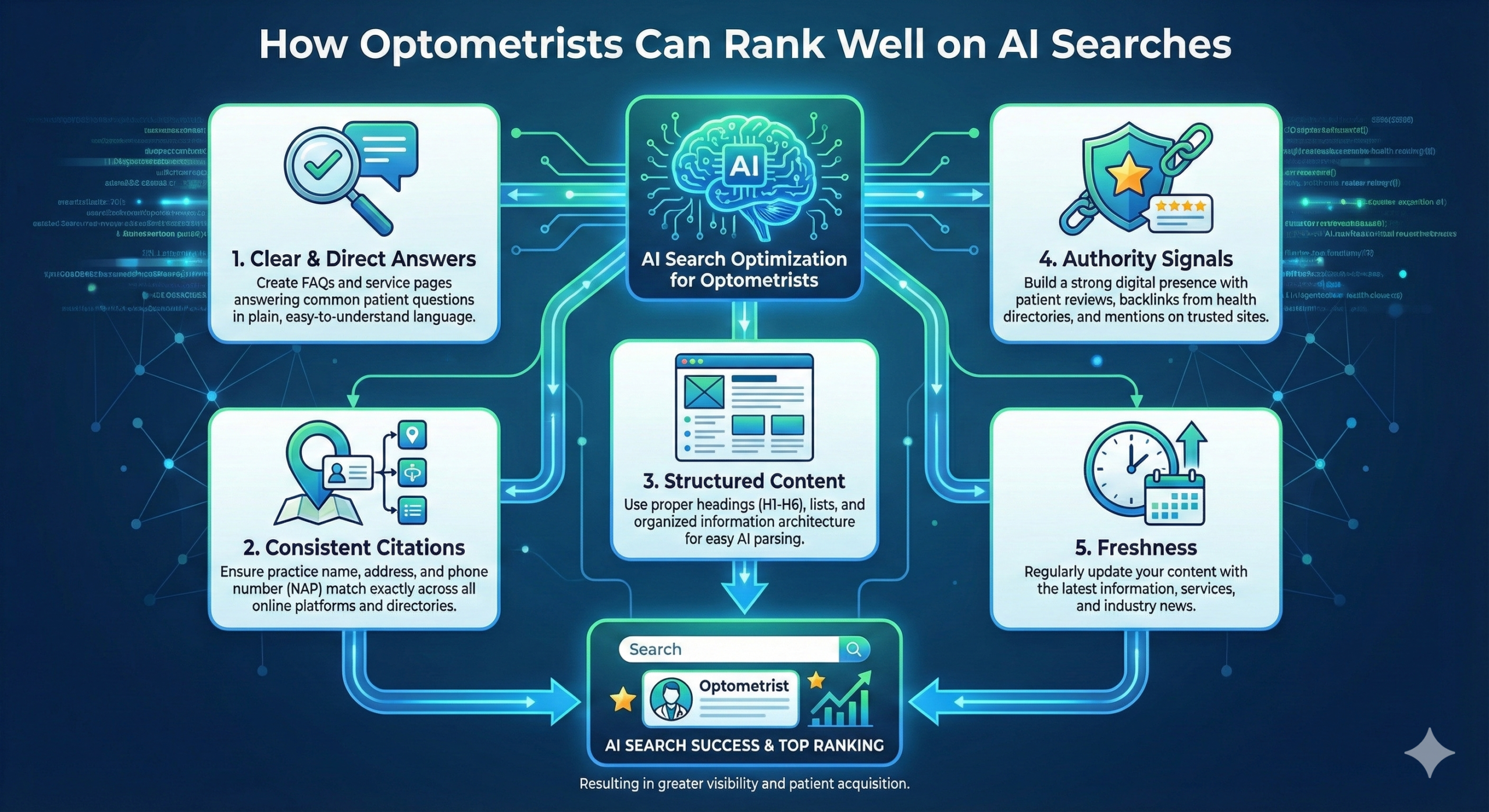
The strategy involves three core areas:
- Structuring your website content so AI systems can extract and cite it easily
- Building local authority signals that AI systems recognize as trust markers
- Creating answer-first content that directly addresses patient questions
How AI Search Differs from Traditional SEO
Traditional SEO focuses on ranking web pages in a list of results. AI search focuses on extracting and synthesizing specific answers from multiple sources.
| Factor | Traditional SEO | AI Search Optimization |
|---|---|---|
| Goal | Rank pages in search results | Get cited in AI-generated answers |
| Content format | Keyword-optimized pages | Answer-first, structured content |
| Success metric | Click-through rate | Citation and visibility |
| Trust signals | Backlinks, domain authority | Consistency, accuracy, structured data |
| Local relevance | Google Business Profile | Multi-platform consistency |
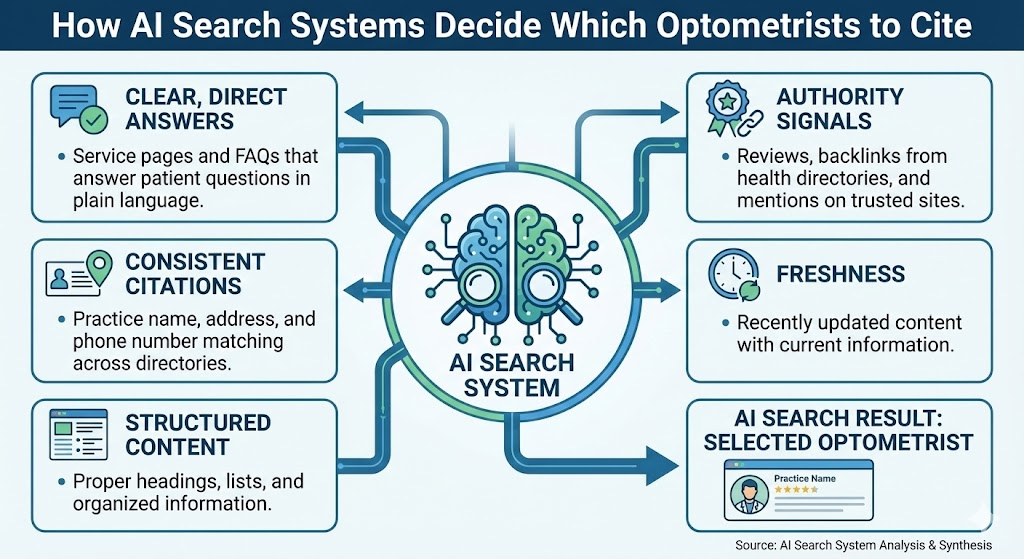
AI systems prioritize content that is easy to chunk, factually consistent across sources, and directly answers specific questions. They do not reward keyword density or traditional ranking tactics.
The Core Ranking Factors for AI Search
Structured, Answer-First Content
AI systems prefer content that states answers immediately rather than building toward a conclusion. Each page on your optometry website should begin with a direct answer to the question it addresses.
For example, a page about pediatric eye exams should state in the first paragraph: children should have their first comprehensive eye exam at 6 months, then at age 3, and again before starting school.
This format allows AI to extract the answer without processing the entire page.
Consistent NAP Across All Platforms
Name, address, and phone number consistency remains critical. AI systems cross-reference information from multiple sources including your website, Google Business Profile, Yelp, Healthgrades, and local directories.
Inconsistencies reduce AI confidence in your data, making citation less likely.
Schema Markup Implementation
LocalBusiness and MedicalBusiness schema help AI systems understand your practice details. Key schema elements for optometrists include:
- Practice name and type
- Address and service area
- Hours of operation
- Services offered
- Accepted insurance providers
- Credentials and certifications
Topical Authority in Eye Care
AI systems recognize when a website covers a topic comprehensively. An optometry practice that publishes detailed content about common conditions, treatment options, and preventive care signals expertise.
This does not mean publishing hundreds of thin pages. It means creating thorough, well-organized content clusters around your core services.
Content Strategy for AI Visibility
Service Pages That Answer Patient Questions
Each service page should answer the primary question a patient would ask about that service. Structure pages with:
- A direct answer in the first two sentences
- What the service involves
- Who benefits from it
- What to expect during the appointment
- How often the service is needed
Condition-Specific Content
Create dedicated pages for conditions you treat. Optometrists should consider pages for:
- Dry eye syndrome
- Myopia management
- Glaucoma screening and monitoring
- Diabetic eye exams
- Computer vision syndrome
- Pediatric vision issues
Each page should follow an answer-first format and include specific details about symptoms, diagnosis, and treatment approaches.
Location-Based Content
For practices serving multiple areas, create location pages that include specific details about serving each community. Generic location pages with only the city name swapped out perform poorly in AI search.
Include details about parking, transit access, and any location-specific services or hours.
Technical Requirements for AI Retrieval
Page Speed and Mobile Accessibility
AI systems factor in user experience signals. Pages that load slowly or display poorly on mobile devices receive lower confidence scores.
Target page load times under 2.5 seconds. Ensure all content is accessible without JavaScript rendering where possible.
Clear Heading Hierarchy
Use H2 and H3 headings to organize content logically. Each heading should describe exactly what the section covers.
Avoid clever or vague headings. “What Dry Eye Treatment Costs” performs better than “Investment in Your Eye Health.”
Internal Linking Structure
Connect related content through internal links. A page about contact lens exams should link to pages about contact lens types, fitting appointments, and care instructions.
This helps AI systems understand the relationship between topics on your site.
Building Local Authority for AI Search
Google Business Profile Optimization
Your Google Business Profile remains a primary data source for AI systems answering local queries. Complete every available field:
- Primary and secondary categories
- Services with descriptions
- Business description using natural language
- Photos updated regularly
- Products if you sell eyewear
- Q&A section with answered questions
Review Generation and Response
AI systems weigh review sentiment and volume when determining which practices to cite. A consistent flow of recent reviews signals an active, trustworthy practice.
Respond to all reviews, positive and negative. Your responses become part of the data AI systems analyze.
Multi-Platform Presence
Maintain accurate, complete profiles on:
- Healthgrades
- Zocdoc
- Yelp
- Insurance provider directories
- Local chamber of commerce listings
Consistency across platforms increases AI confidence in your practice information.
Measuring AI Search Performance
Tracking AI search visibility requires different metrics than traditional SEO.
Brand Mention Monitoring
Use tools that track when your practice name appears in AI-generated responses. This includes mentions in ChatGPT, Perplexity, and Google AI Overviews.
Query Testing
Regularly test relevant queries in multiple AI platforms. Ask questions like:
- “Who is the best optometrist in [your city] for children’s eye exams?”
- “Where can I get a diabetic eye exam in [your area]?”
- “What optometrists near [location] accept [common insurance]?”
Document when and how your practice appears in responses.
Referral Source Analysis
Track website visitors from AI-assisted platforms. Look for referral traffic patterns that indicate AI citation is driving visits.
Common Mistakes That Hurt AI Visibility
Duplicate or Thin Content
Pages with minimal unique content or duplicated text across multiple pages confuse AI systems. Each page must offer distinct value.
Outdated Information
AI systems cross-check information across sources. Outdated hours, old addresses, or discontinued services create inconsistencies that reduce citation likelihood.
Missing Contact Information
Every page should include clear contact information or a path to it. AI systems need to verify that the practice information they cite is complete and actionable.
Over-Optimization
Content stuffed with keywords or written primarily for search engines reads poorly to AI systems designed to evaluate natural language quality.
Timeline for Results
AI search optimization produces results over months, not weeks.
| Timeframe | Expected Progress |
|---|---|
| Month 1-2 | Technical foundation, schema implementation, content audit |
| Month 3-4 | Content development, consistency improvements |
| Month 5-6 | Initial visibility improvements in AI responses |
| Month 6-12 | Consistent citation growth, measurable referral traffic |
Practices with existing strong local SEO foundations typically see faster progress than those starting from scratch.
Getting Started
Begin with an audit of your current content and local presence. Identify gaps in your service coverage, inconsistencies in your business information, and pages that could be restructured for AI retrieval.
Focus first on your core services and the questions patients most commonly ask about them. Build from there.
If you want a clear picture of where your practice stands and what it would take to improve AI search visibility, we can help with that assessment.
Frequently Asked Questions
Is AI search optimization different from regular SEO?
AI search optimization builds on traditional SEO but emphasizes structured content, direct answers, and consistency across sources. The same foundational work supports both, but AI visibility requires more attention to how information is organized and cited.
Do I need to rewrite my entire website for AI search?
No. Start with your most important service pages and FAQs. Ensure they answer questions directly, use proper heading structure, and contain specific information. Incremental improvements are effective.
Can AI search replace Google for finding local optometrists?
AI tools are increasingly used for local searches, but most patients still verify through Google or call directly. AI search is an additional discovery channel rather than a replacement.
How important is content length for AI search ranking?
Length matters less than completeness. A 500-word page that fully answers a question is more valuable than a 2,000-word page with filler. Focus on covering the topic thoroughly without padding.